
The best cycling training plan for beginners usually looks less like an athlete’s spreadsheet and more like a repeatable week you can stick with, even when work runs long or the weather turns. If you’re new to structured riding, the real goal is building consistency, learning effort control, and avoiding the classic trap of going hard every time you clip in.
A lot of beginner plans fail because they assume you already know what “easy” feels like, or they ramp volume too fast. You end up tired, sore, and quietly skipping rides, then blaming motivation. This guide keeps it practical: a simple 8-week progression, clear effort cues, and options for indoors or outdoors.

One more thing before we start, this is training, not medical advice. If you have heart conditions, unexplained dizziness, or you’re returning after a long break, it’s smart to check with a clinician or qualified coach so the plan fits your situation.
What “best” means for a beginner cycling plan
For beginners, “best” rarely means the most intense. It means you improve while still feeling like you could keep doing this next month. A strong beginner plan typically has these features:
- 3–5 rides per week, with at least 1 true rest day
- Most riding easy, with small doses of harder efforts
- Gradual volume increases, plus lighter “recovery weeks”
- Skills and comfort included, not just fitness
- Clear success metrics: you ride more consistently and recover better
According to Centers for Disease Control and Prevention (CDC), adults benefit from regular aerobic activity and muscle-strengthening work during the week, cycling can cover a big part of that, but your plan still needs recovery and progression to be sustainable.
Quick self-check: choose the right starting level
Before you copy a schedule from the internet, be honest about where you are right now. Pick the option that sounds almost “too easy” for Week 1, that’s usually the right call.
Level A: True beginner
- You ride 0–1x/week or rides are under 30 minutes
- You get very sore after riding, or your energy crashes the next day
- You’re still sorting out saddle comfort, shifting, braking
Level B: Some base, no structure
- You ride 2–3x/week casually, mostly the same route
- You can ride 45–75 minutes easy, but hills spike your effort
- You want a plan so your rides stop feeling random
Level C: Returning rider
- You used to ride more, now you’re rebuilding
- Your legs remember, your recovery doesn’t
- You’re tempted to “test yourself” every ride
If you’re Level A, start with 3 rides/week. Level B and C usually handle 4 rides/week, with a strict rule that easy days stay easy.
Effort made simple: use talk test + RPE (no power meter required)
The fastest way to mess up a beginner schedule is riding every day in the “kinda hard” zone. Use RPE (Rate of Perceived Exertion, a 1–10 effort scale) plus the talk test:
- Easy (RPE 2–4): you can speak in full sentences, breathing stays controlled
- Steady (RPE 5–6): you can talk in short phrases, focus increases
- Hard (RPE 7–8): you can say a few words, legs burn, you’re counting minutes
- All-out (RPE 9–10): avoid for now, it adds fatigue without much beginner payoff
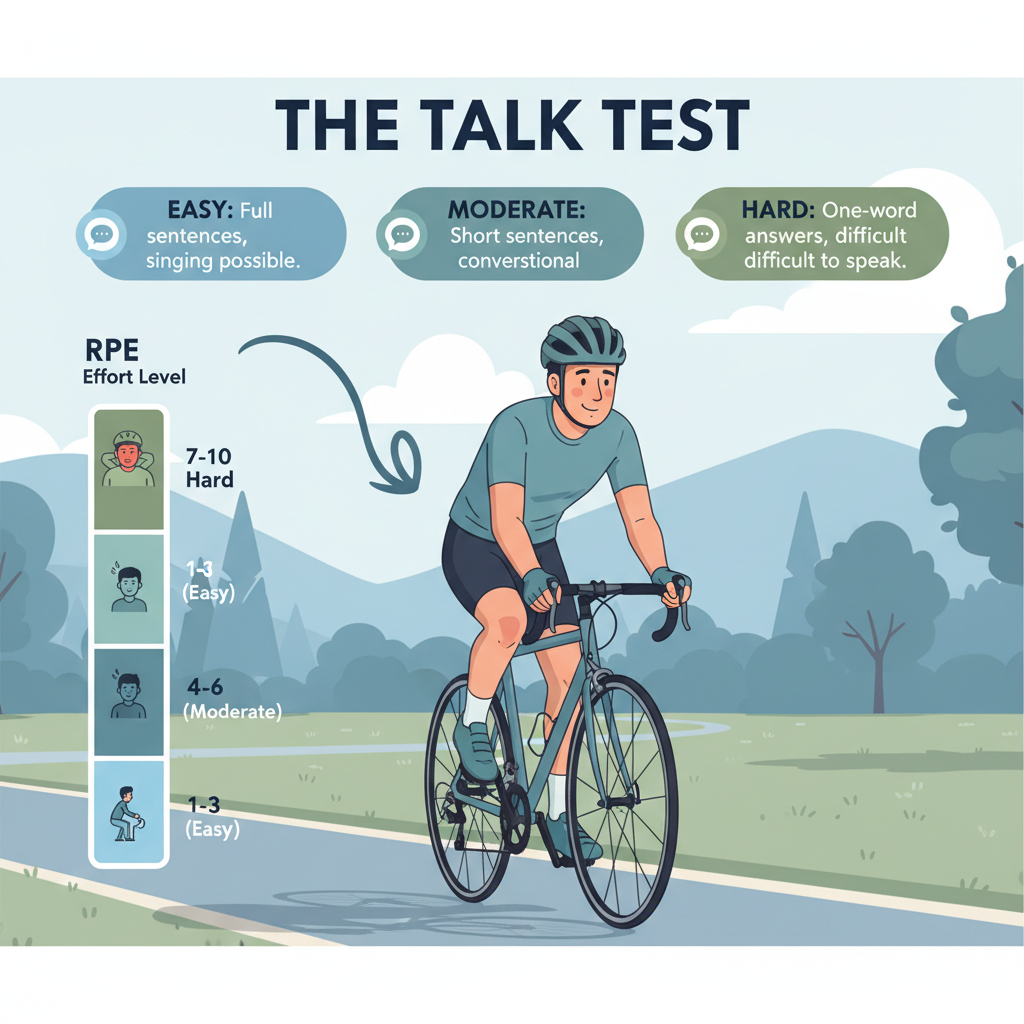
If you use a heart-rate monitor, treat it as a guide, not a judge. Heat, stress, sleep, and caffeine can shift numbers. The “best cycling training plan for beginners” is the one where effort stays in the right bucket most days.
The 8-week beginner cycling training plan (3–4 days/week)
This plan builds from consistency to longer endurance, then adds controlled intensity. If a week feels like too much, repeat it instead of forcing the next one. That choice is boring, and also how people actually progress.
Weekly structure (default)
- Ride 1 (Easy): relaxed spin, technique focus
- Ride 2 (Skills + short efforts): gentle intervals, not maximal
- Ride 3 (Endurance): longest ride of the week, mostly easy
- Optional Ride 4 (Recovery): very easy, 20–40 minutes, or skip
Plan table (adjust times by level)
| Weeks | Rides/Week | Key Focus | Long Ride Target | Hard Work (per week) |
|---|---|---|---|---|
| 1–2 | 3 | Routine + comfort | 45–60 min easy | None, or 4 x 30s light pickups |
| 3–4 | 3–4 | Endurance base | 60–75 min easy | 6 x 1 min hard / 2 min easy |
| 5 | 3 | Recovery week | 50–65 min easy | Skip intensity, keep it smooth |
| 6–7 | 4 | Build + hill strength | 75–100 min easy | 4 x 3 min steady-hard / 3 min easy |
| 8 | 3–4 | Consolidate + test | 90–120 min easy | One controlled “benchmark” ride |
Benchmark idea (Week 8): repeat a familiar loop or a steady climb at a “comfortably hard” pace (RPE 6–7). You’re not hunting a personal record, you’re checking whether the same effort now feels smoother.
What each ride should look like (so the plan works in real life)
Beginners often ask for the “perfect workout,” but the bigger win is keeping rides easy enough that you can show up again. Here are simple templates you can reuse.
Easy ride template (30–60 min)
- 10 min gentle warm-up
- 15–40 min easy spin, cadence comfortable
- 5 min cool-down
- Optional: 4 x 20–30s “fast legs” with lots of easy time between
Interval ride template (45–70 min)
- 15 min easy warm-up
- Main set (example): 6 x 1 min hard with 2 min easy recovery
- 10–15 min easy cool-down
Hard here means controlled, you finish thinking “I could do one more,” not “I need to lie down.” That’s a good beginner intensity rule.
Long ride template (60–120 min)
- Stay mostly easy, especially in the first half
- If you feel good, add 10–15 min steady near the end, not at the start
- Practice fueling and hydration, even on shorter long rides

If you’re training indoors, keep the same structure, but shorten hard sessions slightly. Trainer rides can feel tougher because there’s no coasting, more heat, and fewer micro-breaks.
Practical add-ons: warm-up, strength, fueling, recovery
This is where a “good” plan becomes the best cycling training plan for beginners for many people, because these details prevent quit moments.
Warm-up and cool-down (don’t skip)
- Give yourself 10–15 minutes to ramp up gradually
- Cool down 5–10 minutes, especially after intervals
Strength training (optional but helpful)
According to American College of Sports Medicine (ACSM), muscle-strengthening work is recommended as part of weekly activity for adults. For cyclists, simple strength work can improve comfort and resilience.
- 2 short sessions/week, 20–30 minutes
- Focus on: squats or split squats, hip hinges, calf raises, planks, rows
- Stop 1–2 reps before failure, especially early on
Fueling and hydration (basic guidance)
- Under 60 minutes easy, water is often enough for many riders
- Over 60–90 minutes, consider carbs and electrolytes, what works varies by person
- Don’t “train low” as a beginner, it often just makes you feel terrible and ride less
Recovery signals to respect
- Resting heart rate trending up, sleep getting worse, legs feeling heavy for days
- Irritability, low motivation, unusually sore knees or Achilles
- Fix: reduce intensity first, then reduce volume if needed
Common mistakes beginners make (and how to avoid them)
- Racing every ride: save “hard” for one planned session, everything else supports it.
- Big jumps in long-ride time: adding 10–15 minutes is usually plenty, doubling is where aches show up.
- Ignoring bike fit pain: numb hands, knee pain, or saddle sores are signals, not “toughness tests.”
- Chasing gadgets: power meters are great, but consistency beats gear in the first months.
- Too little easy riding: endurance comes from time at manageable effort, not constant suffering.
When to get help from a coach, bike fitter, or clinician
Sometimes the plan isn’t the issue, the setup or your body is asking for changes.
- Persistent pain (knee, hip, back, numbness) lasting more than a week or worsening, a professional bike fit or clinician may help.
- Health flags like chest pain, fainting, unusual shortness of breath, stop training and seek medical care.
- No progress after 6–8 weeks despite consistency, a coach can spot pacing errors, recovery issues, or unrealistic volume.
- Anxiety in traffic, consider skills clinics, group rides with a beginner-friendly leader, or safer routes.
Key takeaways you can use this week
- Ride easy more often than you think, it’s the foundation most beginners skip.
- Build around a simple week, not a heroic single ride.
- Use talk test and RPE to stay honest about effort.
- Increase long-ride time gradually, and keep a recovery week.
Conclusion: make it boring enough to be consistent
If you want the best cycling training plan for beginners, aim for a week you can repeat, not a week that impresses you. Put three rides on your calendar, keep two of them truly easy, and let the long ride grow a little at a time. In about two months, you typically notice fewer “dead legs” days and more control on hills, which is the kind of progress that actually sticks.
Your next step is simple, pick your starting level, choose 3 or 4 ride days, and run Week 1 exactly as written. If you finish thinking “I could do more,” good, that means you’ll show up next week.
FAQ
- How many days a week should a beginner cyclist train?
Most beginners do well on 3 days per week, then add a fourth easy day if recovery stays solid and life schedule allows. - How long should my long ride be as a beginner?
Start with a duration you can finish comfortably, often 45–60 minutes, then add 10–15 minutes when that feels routine, not heroic. - Is indoor cycling okay for a beginner training plan?
Yes, and it can be safer and more consistent, but it may feel harder because there’s less coasting, so shortening intervals slightly is common. - Do I need intervals in the best cycling training plan for beginners?
You don’t need them in the first couple of weeks, but small controlled efforts can help you handle hills and pace changes without turning every ride into a race. - What if I miss a week of training?
Don’t “make up” missed rides, just restart with the previous week’s workload, your body usually responds better to stepping back than cramming. - How do I know if I’m riding easy enough?
If you can speak in full sentences and finish the ride feeling refreshed rather than depleted, you’re probably in the right zone for easy days. - When should I consider a bike fit?
If you have recurring knee pain, numb hands, saddle sores that won’t settle, or you constantly shift around to get comfortable, a fit often saves time and frustration.
If you’re trying to follow the best cycling training plan for beginners but your week keeps blowing up, it may help to simplify the schedule into two “must-do” rides plus one flexible option, or to get a coach to tailor volume, pacing, and recovery around your real calendar.