
Ab exercises no equipment can work extremely well, but only if you stop chasing “burn” and start training the core the way it actually functions, resisting movement, transferring force, and staying stable while you breathe.
If you’ve tried random crunch variations and still feel like your neck does more work than your abs, you’re not alone. Most at-home core routines fail for two boring reasons, poor positioning and no progression. The fix is straightforward, and you don’t need gear.
Below you’ll get a tight menu of the most practical moves, how to choose the right level, and a few “real life” cues that make these exercises feel different immediately. I’ll also give you a simple workout template you can repeat without overthinking.
How your abs really work (and why this changes exercise choice)
Your “abs” are not just the six-pack muscle. Your core includes the rectus abdominis, obliques, transverse abdominis, and deep stabilizers around the spine and hips. In day-to-day movement, their job is often to prevent unwanted motion, not create big bending reps.
That’s why no-equipment core training tends to feel better when you prioritize:
- Anti-extension: resisting low-back arching (planks, dead bugs)
- Anti-rotation: resisting twisting (bird dog holds, slow cross-body patterns)
- Controlled flexion: crunching only when you can keep ribs “down” and neck relaxed
According to the American Council on Exercise (ACE), effective ab training depends heavily on proper technique and spinal positioning, not just piling on reps.
Quick self-check: choose the right “no equipment” ab level
Before you copy a routine, take 60 seconds to check where you fit. This saves you from doing advanced moves with beginner control, which usually turns into hip flexor work and low-back irritation.
You’re probably at the beginner level if:
- You can’t hold a plank 20–30 seconds without your low back dipping
- Dead bug makes your ribs flare up and your lower back peel off the floor
- Crunches feel mostly in the neck or front hips
Intermediate tends to fit if:
- You can keep a steady plank 45–60 seconds with calm breathing
- You can extend one leg in dead bug without losing back contact
- You can do a controlled reverse crunch without swinging
Advanced is realistic if:
- Side plank holds stay stacked and stable for 45+ seconds per side
- Hollow body variations feel solid without low-back strain
- You can slow everything down and still keep form
Best ab exercises no equipment (the shortlist that actually covers your core)
Here are the moves worth repeating. You’ll notice fewer “cute” variations and more staples, because staples are where progression happens.
1) Dead Bug (anti-extension)
How: Lie on your back, knees over hips, arms up. Exhale, gently tuck ribs toward pelvis, keep low back heavy on the floor. Reach opposite arm and leg away slowly, return, switch.
- Make it easier: shorten the leg reach, keep knees more bent
- Make it harder: extend the leg lower without back arching, slow tempo
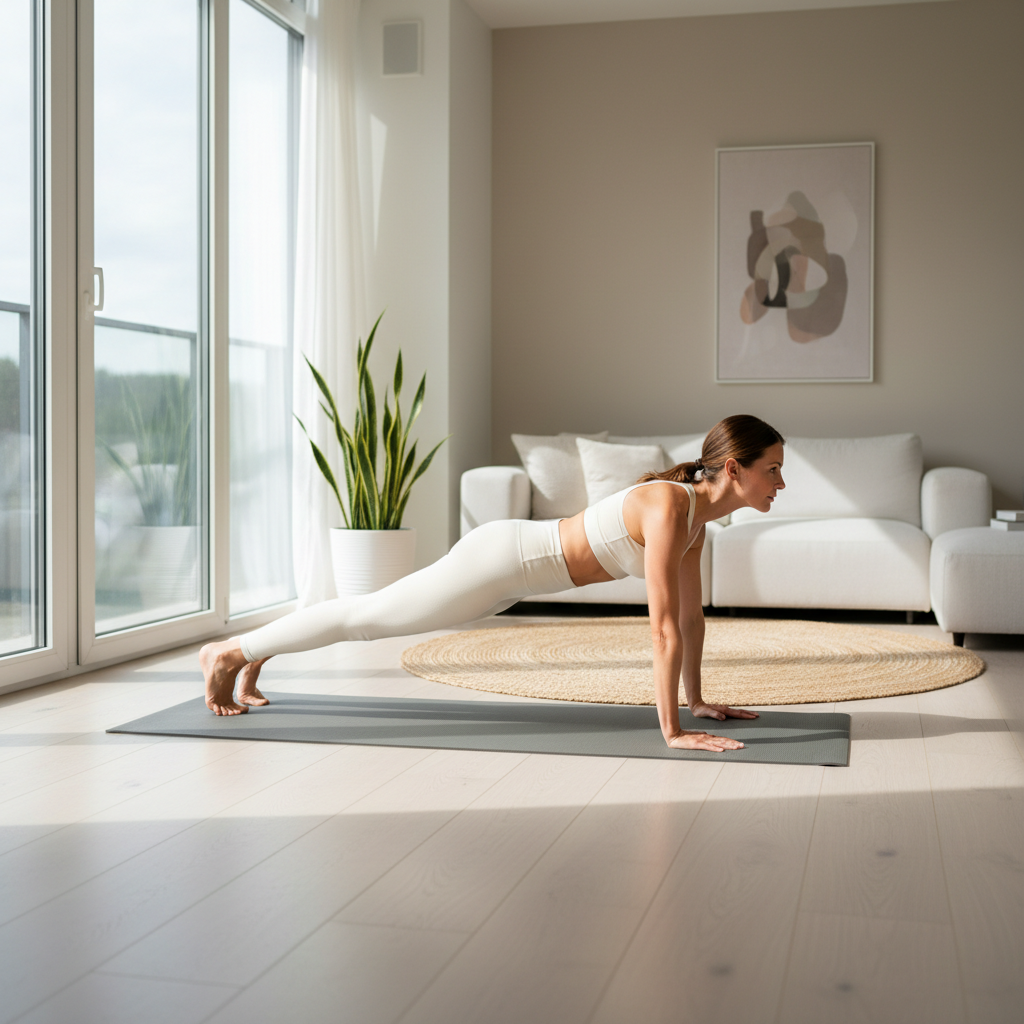
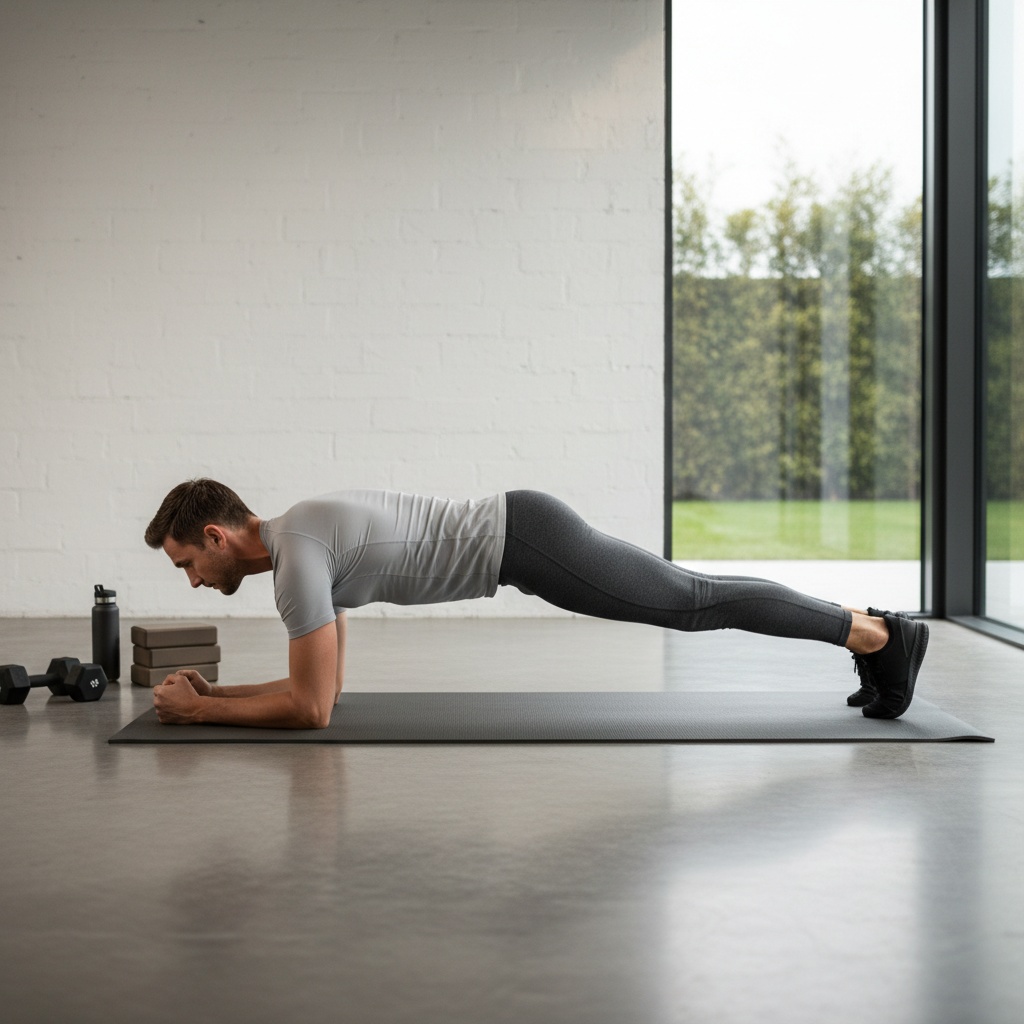
2) Forearm Plank (anti-extension)
How: Elbows under shoulders, toes tucked. Think “ribs down, glutes on, push the floor away.” Breathe quietly through the nose if possible.
- Common fix: if hips sag, shorten the hold and build time
- Progression: add shoulder taps very slowly (only if hips stay quiet)
3) Side Plank (anti-lateral flexion)
How: Elbow under shoulder, legs stacked or staggered. Lift hips, keep head, ribs, pelvis aligned. Don’t let the top shoulder roll forward.
- Make it easier: bottom knee down
- Make it harder: reach top arm under and back, slow and controlled
4) Bird Dog (anti-rotation)
How: Hands under shoulders, knees under hips. Extend opposite arm and leg, pause 2–3 seconds, return with control. Hips stay level, no twisting.
- Make it harder: longer pauses, slower returns, lighter touch on the floor
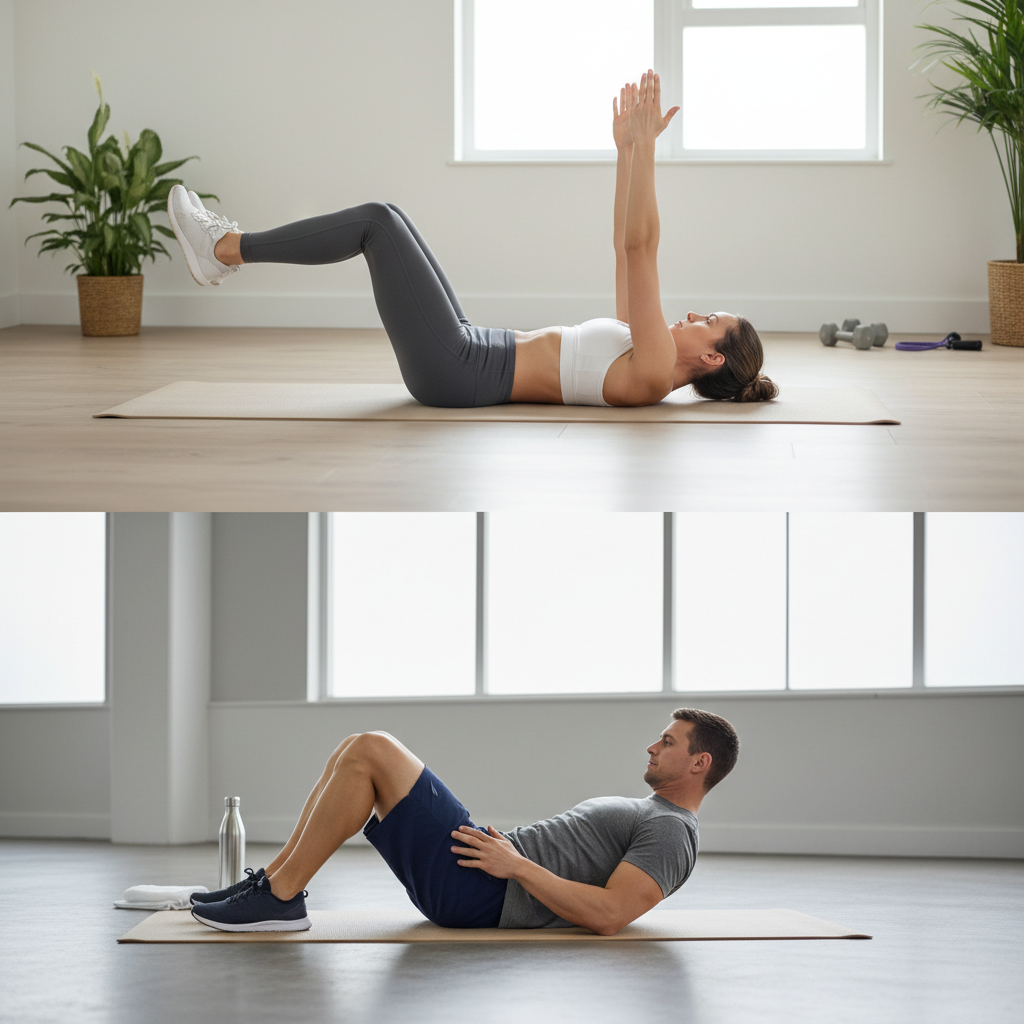
5) Reverse Crunch (controlled flexion)
How: On your back, knees bent. Exhale and curl pelvis up slightly so tailbone lifts, then lower slowly. This is small, not a swing.
- Don’t do: rocking momentum or throwing legs overhead
6) Hollow Hold (advanced anti-extension)
How: On your back, press low back into the floor, lift shoulders and legs. Hold the “banana” shape without losing contact at the low back.
- Scale it: tuck knees, keep arms by sides, hold shorter
A simple progression table (so you don’t get stuck)
Most people don’t need more exercises, they need a cleaner ladder. Use this table to progress without guessing.
| Movement Pattern | Beginner | Intermediate | Advanced |
|---|---|---|---|
| Anti-extension | Dead bug (short range) | Plank 30–60s | Hollow hold 20–40s |
| Anti-rotation | Bird dog (pause) | Slow bird dog (long lever) | Bear hover shoulder taps (controlled) |
| Side stability | Side plank, knee down | Side plank, legs stacked | Side plank with reach-through |
| Controlled flexion | Reverse crunch (tiny lift) | Reverse crunch (slow eccentric) | Strict toe tap to reverse curl combo |
Two no-equipment ab workouts you can repeat (15–20 minutes)
Pick one template and run it 2–4 times per week. If you also lift or run, 2 times often feels plenty.
Workout A: Stability-first (beginner to intermediate)
- Dead bug: 6–10 reps per side, slow
- Forearm plank: 3 x 20–45 seconds
- Side plank: 2–3 x 15–40 seconds per side
- Bird dog: 6–10 reps per side with 2-second pause
How to progress: add 5 seconds per hold each week, or slow the tempo, not both at once.
Workout B: Strength + control (intermediate to advanced)
- Hollow hold: 3 x 15–35 seconds (scaled as needed)
- Reverse crunch: 3 x 8–12 reps, 3-second lower
- Side plank reach-through: 2–3 x 6–10 per side
- Plank shoulder taps: 2–3 x 10–20 total taps, slow
If your form breaks at rep 7, treat 6 as your “real” set for now, and build from there.
Technique cues that make these exercises hit your abs (not your neck or hips)
These cues sound small, but they’re usually the difference between “I feel nothing” and “okay, there it is.”
- Exhale first: a full exhale helps ribs come down, which often lets the abs engage more naturally.
- Keep the pelvis honest: if your low back arches, shorten range or choose an easier variation.
- Slow beats hard: when you remove momentum, weak links show up fast, in a good way.
- Neck stays long: on any curling move, think “chin slightly tucked,” not “head pulled forward.”
According to the National Academy of Sports Medicine (NASM), core training should emphasize stabilization and controlled movement patterns to support posture and reduce compensations.
Common mistakes with ab exercises no equipment (and what to do instead)
- Doing max reps daily: soreness feels productive, but recovery matters. Try 2–4 sessions weekly and progress holds or tempo.
- Only doing flexion (endless crunches): mix in anti-extension and side stability, your back often feels better.
- Letting hip flexors take over: if legs dominate, bend knees more, limit range, and prioritize dead bug and plank progressions.
- Rushing the hard stuff: hollow holds and leg-lower variations punish sloppy positioning. Earn them.
When to slow down or ask a professional
If you feel sharp pain, numbness, or pain radiating into a leg, it’s smart to stop and consider getting evaluated. Lingering low-back pain during core work often means the exercise selection or positioning needs adjustment.
If you’re postpartum, managing a hernia, or suspect diastasis recti, many people still train their core successfully, but exercise choice matters a lot, so it may help to consult a qualified physical therapist or certified coach for a safer progression.
Key takeaways + a practical next step
- Build around stability and resist movement before chasing harder flexion variations.
- Progress one variable, more time, slower tempo, or longer lever, not everything at once.
- Keep it repeatable: two short sessions done consistently beat random “ab finishers.”
Pick Workout A or B, run it for 3 weeks, and track one metric, total seconds held in planks/side planks, or the slowest clean reps you can manage in reverse crunch. That’s your proof you’re improving.
FAQ
What are the best ab exercises no equipment for beginners?
Dead bug, forearm plank, side plank with the bottom knee down, and bird dog cover the core’s main jobs without forcing big ranges of motion. They also make it easier to feel whether your low back stays stable.
How often should I train abs at home without equipment?
Many people do well with 2–4 sessions per week, depending on the rest of their training and recovery. If form degrades or your low back feels irritated, scale volume down and tighten technique.
Why do my hip flexors take over during leg raises?
Leg raise variations can shift load to the hip flexors when the pelvis tips forward and the low back arches. Bending the knees, shortening range, and using dead bug progressions usually brings the work back to the abs.
Can no-equipment ab workouts help with a visible six-pack?
They can strengthen and thicken the abdominal muscles, which helps definition. Visibility still depends a lot on overall body fat levels, which typically ties back to nutrition, daily activity, and genetics.
Are crunches bad for your back?
Crunches are not automatically “bad,” but they can be a poor choice if you compensate through your neck or repeatedly flex a sensitive spine. If you have back history, controlled stability work may feel safer, and a clinician can advise for your case.
How do I make ab exercises harder without equipment?
Extend your lever (straighter legs, longer reaches), slow the tempo, add pauses, or increase total time under tension. The goal is more control, not just more sweat.
What if I only have 5 minutes?
Do one quality circuit: 30 seconds plank, 30 seconds side plank per side, then 6–8 dead bug reps per side. Keep it strict and repeat once if time allows.
If you’re trying to build a consistent at-home routine and want a more “set-and-follow” plan, it often helps to use a simple weekly template with built-in progressions, so you spend less time searching and more time doing the work.