
Senior balance exercises can feel frustrating at first, especially if you notice wobbling during simple tasks like turning, stepping off a curb, or reaching into a cabinet, but the good news is that balance is trainable at most ages when you practice the right things, the right way.
Most people search this topic after a “small scare” moment, a near-fall, or a growing fear of being unsteady. That fear is valid, and it can quietly shrink your world if you start avoiding walks, stairs, or social outings.

This guide focuses on practical, home-friendly balance drills, how to pick the safest starting level, and how to progress without turning every session into a stressful test. You’ll also see a simple weekly plan and a few cues that make balance practice “click” for many seniors.
Why balance changes with age (and what you can improve)
Balance is a teamwork problem, your brain, eyes, inner ear, nerves, joints, and muscles constantly negotiate where your body is in space. When one piece gets a little noisier, the whole system feels less reliable.
- Strength and power drop, especially in hips, calves, and the front of the shin. That matters when you need a quick correction after a slip.
- Joint mobility shifts, ankles and hips often stiffen, so your body has fewer options to “catch” you.
- Sensation in feet can dull for many reasons, including circulation issues or neuropathy, which makes the ground feel less predictable.
- Vision changes can reduce contrast or depth cues, so turning in dim light becomes harder.
- Medications and blood pressure swings may contribute to dizziness for some people. According to CDC guidance on fall prevention, reviewing medicines is a common step in reducing fall risk.
Here’s the encouraging part: you can usually improve strength, reaction time, coordination, and confidence with consistent practice. Even small gains can translate into smoother walking and safer turns.
Quick self-check: which balance level fits you today?
Before you try new senior balance exercises, it helps to identify your “start line.” Pushing too hard too soon is a common reason people quit, not because they can’t improve, but because the practice feels scary.
Pick the statement that matches you most days
- Level 1 (Support needed): You prefer holding a counter or sturdy chair for most standing tasks, you feel unsteady when you look over your shoulder.
- Level 2 (Light support): You can stand without holding on, but you like fingertips on a surface for new drills, you occasionally drift when walking and turning.
- Level 3 (Independent): You walk confidently on flat ground, but uneven surfaces, quick direction changes, or single-leg tasks feel challenging.
Safety rule: if you’ve had a recent fall, fainting, new numbness, new severe dizziness, or sudden changes in walking, it’s wise to talk with a clinician or physical therapist before progressing.
Safety setup: small details that prevent big problems
Balance training works best when your environment is “boring,” no surprises, no tripping hazards, no sliding rugs. That way your nervous system can focus on the exercise, not the room.
- Use a sturdy chair or countertop within reach, not a rolling chair.
- Wear supportive shoes, or go barefoot only if your provider says it’s appropriate for your feet.
- Practice near good lighting, especially if you’re sensitive to dim rooms.
- Keep sessions short, 5–15 minutes is plenty early on.
- Stop if you feel chest pain, spinning dizziness, or unusual shortness of breath, and consider seeking medical advice.
According to NIA (National Institute on Aging), balance and strength activities are a key part of staying independent as you age, and they emphasize choosing activities that are safe and appropriate for your level.
Core senior balance exercises (with easy progressions)
You don’t need dozens of drills. A small menu, repeated consistently, tends to beat random variety. Choose 4–6 moves, rotate them, and progress one variable at a time.
1) Sit-to-stand (the “hidden” balance builder)
This is strength plus balance, because you shift your center of mass forward and stabilize at the top.
- How: Sit tall, feet under knees, stand up without using hands if possible, then sit slowly.
- Start: 2 sets of 5–8 reps.
- Progress: Lower chair height slightly, slow the lowering phase, or pause standing for 2 seconds.
2) Weight shifts (side-to-side and front-to-back)
Many older adults “freeze” in the middle and avoid shifting, which makes real-life balance harder.
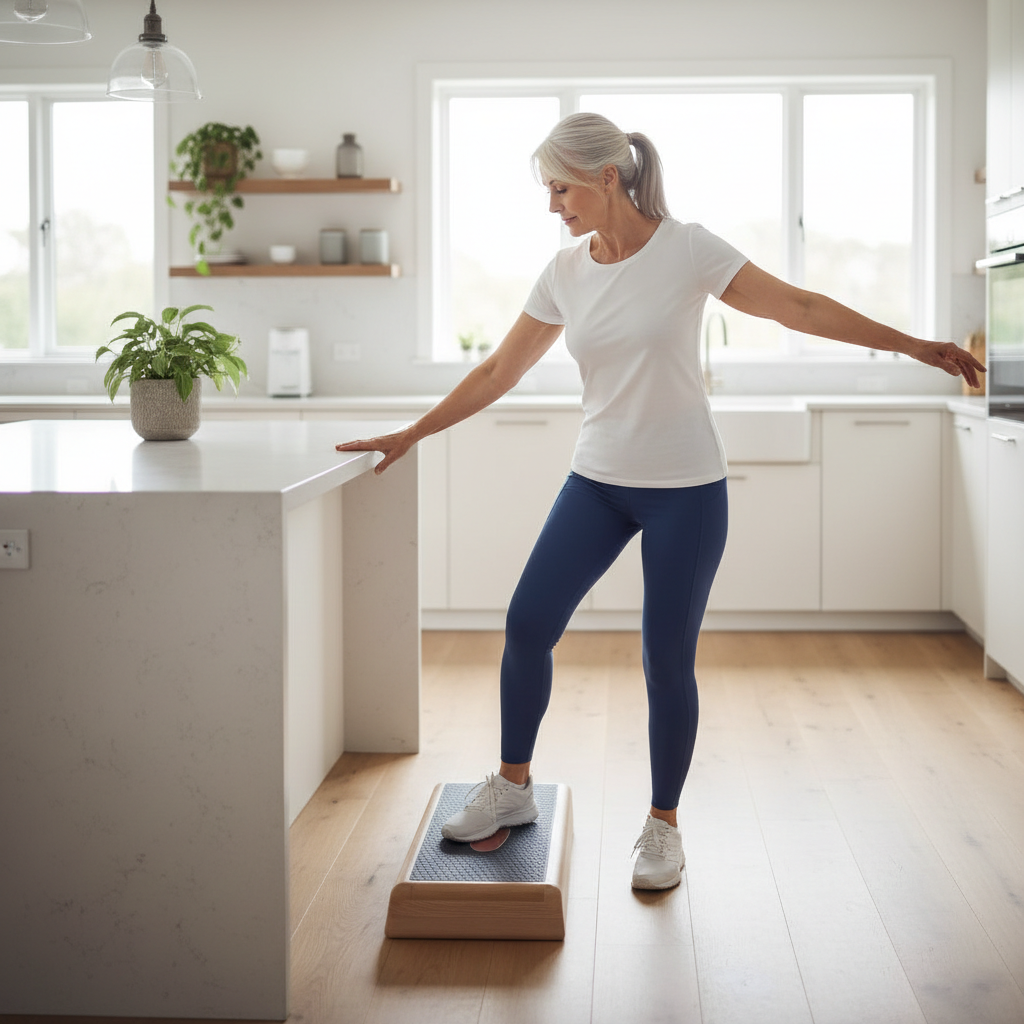
- How: Stand tall holding a counter lightly, shift weight to one foot until you feel pressure in that heel, then return to center.
- Start: 10 shifts each direction.
- Progress: Use fingertip support only, or reduce hand contact.
3) Tandem stance (heel-to-toe hold)
This mimics the narrow base of support you get during walking.
- How: One foot directly in front of the other, hold 10–30 seconds while lightly touching a surface.
- Start: 3 holds per side.
- Progress: Switch from holding to hovering your fingers, then turn your head slowly left and right.
4) Single-leg stand (with “permission” to hold on)
It’s normal to need support. The goal is quality, not bravado.
- How: Stand near a counter, lift one foot slightly, hold 5–20 seconds.
- Start: 3 holds per side.
- Progress: Increase time, reduce hand support, or add a gentle toe tap pattern.
5) Step taps and step-ups (real-life curb practice)
Controlled stepping trains coordination and confidence, especially if curbs or stairs feel stressful.
- How: Tap one foot onto a low step, return, alternate. If safe, step up and down with a rail nearby.
- Start: 8–12 taps per side.
- Progress: Slightly higher step, slower tempo, or add a pause at the top.
6) Heel-to-toe walk (tandem walking)
Walk along a counter or wall, placing the heel of one foot directly in front of the toes of the other.
- Start: 5–10 steps, turn carefully.
- Progress: Increase steps, reduce hand contact, keep eyes forward instead of watching your feet.
A simple 4-week plan you can actually stick to
Consistency matters more than marathon sessions. Many people do better with short practice, 3–5 days per week.
| Week | Frequency | Main focus | What “progress” looks like |
|---|---|---|---|
| 1 | 3 days/week | Learn moves, prioritize safety | Less fear, smoother transitions |
| 2 | 4 days/week | Add time under tension | Longer holds, fewer grabs |
| 3 | 4–5 days/week | Add stepping and turns | More control during direction changes |
| 4 | 5 days/week | Gentle challenge, real-life carryover | Better curb confidence, steadier gait |
Example session (10–15 minutes): sit-to-stand, weight shifts, tandem stance, step taps, then a short easy walk focusing on tall posture and relaxed breathing.
If a session leaves you wiped out or very sore for two days, that’s usually a sign to reduce volume or intensity. With senior balance exercises, “a little and often” tends to win.
Key technique cues that make balance feel easier
Sometimes it’s not the exercise, it’s how you do it. These cues often help people steady faster.
- Soft knees, tall spine: Locked knees can make you feel like a stiff pole.
- Tripod foot: Feel big toe, little toe, and heel on the floor, not just the outer edge.
- Eyes steady: Pick a point on the wall. When you’re ready, add slow head turns as a progression.
- Breathe on purpose: Holding your breath increases tension and wobble for many people.
Common mistakes (and what to do instead)
- Skipping strength work: Balance drills without leg strength can plateau. Keep sit-to-stand, calf raises, and hip work in your week if tolerated.
- Going straight to “no hands”: Light support is not cheating, it lets you practice longer with better form.
- Practicing only when you feel steady: You don’t need to feel perfect, but you do need a safe setup and manageable challenge.
- Ignoring footwear and vision: Slippers, poor lighting, and outdated prescriptions can undermine progress more than people expect.
When to get professional help (and why it’s not overreacting)
Some balance issues are straightforward deconditioning, others involve vestibular function, neurological changes, or medication side effects. Getting clarity saves time.
- New or worsening dizziness, spinning sensations, or fainting episodes
- Sudden weakness, numbness, or changes in speech or vision
- Frequent falls, or you avoid walking because fear feels overwhelming
- Foot numbness or pain that makes it hard to feel the ground
A physical therapist can assess gait, strength, and vestibular factors, then tailor senior balance exercises to your home and health history. If you’re unsure where to start, your primary care clinician can usually point you in the right direction.
Conclusion: steady progress beats perfect balance
Balance training does not need to be dramatic to be effective. If you practice a small set of drills, keep the environment safe, and progress in tiny steps, you often build steadiness and confidence that shows up in daily life.
Two good next actions: pick 4 exercises from this guide and schedule 10 minutes, 4 days this week, then note one real-world task that feels easier, like turning, stepping up, or walking while carrying something light.
Key takeaways
- Start where you feel safe, support is part of the plan, not a failure.
- Train both strength and balance, sit-to-stand and stepping drills matter.
- Progress one variable at a time, more seconds, less hand contact, or slightly harder steps.
- Ask for help when symptoms change or fear limits your life.
FAQ
- How often should seniors do balance exercises?
Many people do well with 3–5 short sessions per week. If you’re just starting, consistency matters more than long workouts, and recovery should feel manageable. - Are senior balance exercises safe if I use a walker?
They can be, but it depends on your stability and medical history. Practicing near a counter with a clinician-approved plan is often a safer approach than trying to balance away from support. - What are the best balance exercises for fall prevention at home?
For most older adults, sit-to-stand, weight shifts, tandem stance, step taps, and heel-to-toe walking cover the basics. The “best” mix is the one you can do safely and repeat weekly. - How long until balance improves?
Some people notice confidence gains within a couple weeks, while physical changes can take longer. If you track small wins, like fewer stumbles during turns, you’ll usually see progress sooner than you expect. - Should I practice with eyes closed to improve balance?
Eyes-closed drills can be useful, but they raise difficulty quickly and may increase fall risk. Many seniors should master eyes-open versions first, ideally with professional guidance. - What if I feel dizzy during balance training?
Stop and sit, then reassess. Dizziness has many causes, and it’s smart to discuss it with a healthcare professional, especially if it’s new, severe, or getting worse. - Can strengthening alone fix my balance?
Strength helps a lot, but balance is also coordination, reaction timing, and sensory input. A combined plan usually works better than focusing on one piece.
If you’re trying to build a simple routine and want something more plug-and-play, consider using a guided program or working with a physical therapist who can match progressions to your home setup, medical history, and confidence level without pushing you faster than you’re ready for.