
Running stretching guide questions usually pop up when your calves feel like rocks, your hips feel stuck, or your “easy run” turns into a stiff walk the next day. The good news, you do not need a 30-minute routine to get real benefits, you need the right stretches at the right time.
Most runners get tripped up by one thing: treating pre-run and post-run stretching as the same job. Before you run, you’re preparing tissue and your nervous system for impact and speed. After you run, you’re calming things down and restoring length where you tighten up.

This guide keeps it practical: how to decide what you need today, what to skip, and a simple routine you can repeat without overthinking. If you have sharp pain, numbness, or swelling, treat this as general info and consider checking in with a qualified clinician.
Why stretching “before vs after” feels confusing (and why it matters)
Stretching sits in a messy spot between “feels good” and “does it help performance.” Reality sits in the middle. The main issue is timing and type.
- Before running: long static holds can make some people feel a bit sluggish, dynamic mobility usually fits better because it raises temperature and rehearses movement.
- After running: your nervous system is already fired up, gentler static stretching can help you downshift and address the spots that clamp down.
- For injury risk: stretching alone rarely “prevents injuries,” but a smart warm-up plus sensible training load often does more than forcing flexibility.
According to the American College of Sports Medicine (ACSM), flexibility training is typically recommended as part of a balanced program, and dynamic stretching is often used in warm-ups while static stretching fits well after activity.
Quick self-check: what your body is asking for today
Use this quick scan before you decide what to do. No need to diagnose yourself, just notice patterns.
Signs you need more dynamic warm-up (pre-run)
- First mile feels creaky, then you “loosen up” later
- You sit most of the day and feel hip stiffness when you stand
- You’re running hills, intervals, or a race effort
Signs you need more recovery work (post-run)
- Calves and hamstrings feel tight later that day or next morning
- Front of the hip feels short after faster running
- You notice stride gets choppy as you fatigue
Red flags to treat differently
- Sharp pain that changes your gait
- Swelling, heat, bruising, or a sudden “pop” sensation
- Numbness/tingling down the leg
If any red flag shows up, stretching harder usually is not the move, it’s safer to scale back and consult a physical therapist or sports medicine professional.
Before running: a 5–8 minute dynamic warm-up that actually helps
Think “mobilize and activate,” not “force flexibility.” This part of the running stretching guide is about preparing ankles, hips, and trunk to handle load.
Do this sequence (pick 5–6 moves)
- Brisk walk to easy jog for 2 minutes, get warm first
- Leg swings front-to-back, 8–12 each side, stay controlled
- Leg swings side-to-side, 8–12 each side, small range then bigger
- Walking lunges 6–10 each side, tall torso
- World’s greatest stretch (lunge + rotation), 3–5 each side
- Calf raises 10–15 reps, pause at the top
- High knees or butt kicks 20–30 seconds, light and quick
- Strides (optional): 2–4 x 15–20 seconds at “smooth fast,” full recovery
Keep the effort low until your breathing and joints feel settled. If you’re doing speedwork, the strides matter more than more stretching.
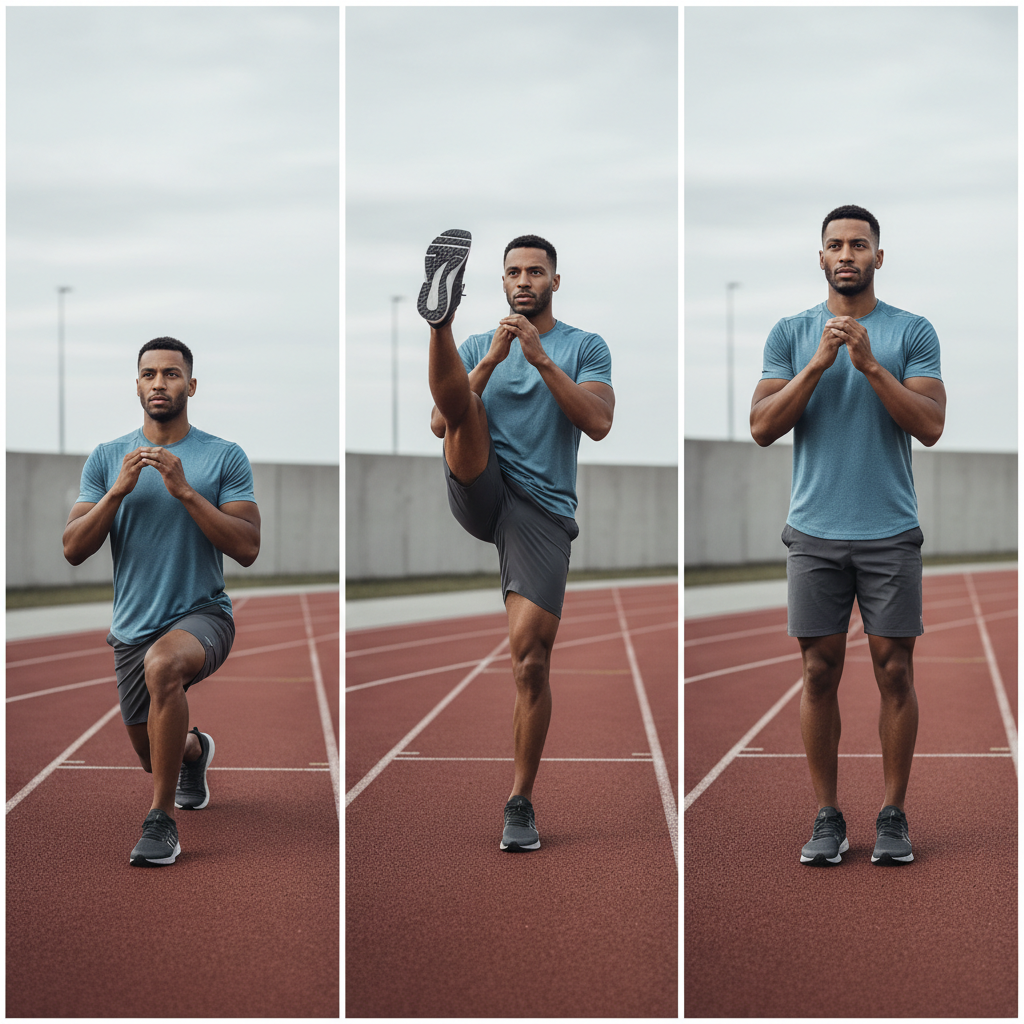
Key point: if a move makes you feel unstable, pinchy, or painful, shorten the range and slow it down. Dynamic does not mean sloppy.
After running: a 8–12 minute cooldown + static stretches
Post-run stretching is less about performance and more about keeping common problem areas from staying “stuck.” You’ll get more out of it if you cool down for a minute or two first.
Step 1: downshift (2–3 minutes)
- Walk until your breathing drops
- Take a few slow breaths, long exhale, shoulders down
Step 2: hold these stretches (20–45 seconds each, 1–2 rounds)
- Calf stretch (straight knee for gastrocnemius, bent knee for soleus)
- Hip flexor stretch (half-kneeling, squeeze glute gently on the back leg)
- Hamstring stretch (keep spine long, hinge from hips)
- Glute/piriformis stretch (figure-4 position)
- Quad stretch (kneeling or standing, pelvis neutral)
According to the American Council on Exercise (ACE), static stretching is commonly performed after workouts, with holds often in the 15–60 second range depending on the goal and comfort.
If your runs are long or you cramp easily, rehydration and fueling can matter as much as stretching. Tightness sometimes is just fatigue in disguise.
What to stretch for your running type (use this table)
This is where most “generic routines” fall apart. The best choices depend on what you just did and how your body tends to respond.
| Run type | Before run focus | After run focus |
|---|---|---|
| Easy run | Short dynamic warm-up, gentle mobility | Calves, hips, light hamstring and quad holds |
| Intervals / tempo | More activation + strides, ankle/hip prep | Hip flexors, calves, glutes, easy cooldown walk |
| Long run | Extra time warming up, don’t rush first mile | Calves/feet, quads, hips, add gentle thoracic rotation |
| Trail / hills | Ankles, calves, lateral hip stability drills | Calves (both variations), quads, glutes, feet rolling if helpful |
Common mistakes that waste time (or make things worse)
A friendly warning: many runners stretch faithfully and still feel tight because the routine misses the real driver.
- Stretching cold: it often just feels intense, not effective. Warm up first.
- Pushing into “pinchy” hip sensation: hip impingement-like symptoms can flare with deep positions, keep range comfortable.
- Only stretching, never strengthening: recurring calf or IT-band discomfort often improves more with strength and load management than more pulling.
- Holding your breath: tension goes up, range goes down, exhale slowly during holds.
- Copying a pro runner routine: their training volume and mobility baseline might be nothing like yours.

If you keep feeling tight in the same spot, consider the simple possibility: you may be increasing mileage or intensity faster than your tissues adapt. Stretching can’t fully cover that gap.
Practical plans you can follow (2 options)
Here are two templates runners actually stick with. Use the short one on most days, save the longer one for harder sessions.
Option A: “I just want something simple” (about 10 minutes total)
- Before: 2 min walk/jog + leg swings + walking lunges + calf raises
- After: 2 min walk + calves + hip flexor + glute stretch
Option B: “My hips and calves always tighten up” (about 15–20 minutes total)
- Before: add world’s greatest stretch, high knees, and 2–3 strides
- After: add hamstring and quad holds, do two rounds, breathe slowly
Key point: consistency beats complexity. A modest routine done four days a week usually helps more than an elaborate routine done once.
When to get help from a professional
If you’re dealing with recurring pain in the same place, stretching can become a distraction from the real fix. It may be time to talk to a pro when:
- Symptoms last more than 2–3 weeks despite easier training
- Pain changes your stride, or you stop enjoying running
- You have a history of stress fractures, tendon issues, or major ankle sprains
- You’re unsure whether it’s soreness vs injury
A physical therapist, certified athletic trainer, or sports medicine clinician can check strength, mobility, and running mechanics, then match stretches with the right strengthening plan.
Conclusion: keep stretching in its lane
This running stretching guide boils down to a simple split: dynamic before to feel smooth and ready, static after to recover and keep your usual tight spots from locking up. If you want one action today, do a 5–8 minute warm-up before your next run, then add just three post-run holds for calves, hip flexors, and glutes.
If you keep guessing, jot down what feels tight and what run you did, patterns show up fast, and your routine stops being random.
FAQ
Is it bad to do static stretching before running?
Not always, but long holds right before faster running can make some people feel less springy. If you like static stretching, keep it brief and follow with dynamic moves and an easy build-up.
How long should I stretch after a run?
Many runners do well with 8–12 minutes, focusing on a few high-payoff areas. If time is tight, pick calves, hip flexors, and glutes and hold each 20–45 seconds.
What if stretching makes me feel tighter later?
That can happen if you push too hard or stretch a tired muscle aggressively. Back off intensity, shorten holds, and make sure your training load and recovery (sleep, fueling) are not the bigger issue.
Should runners stretch every day or only on run days?
Run days work well because your tissue is warm, and the habit is easy to attach to. On non-run days, light mobility can help if you sit a lot, but it does not need to be a big session.
Do I need to stretch my IT band?
The IT band itself is tough to “stretch” in a direct way. Many people get more relief by working glute strength, hip control, and addressing lateral hip tightness, stretching can be part of it but rarely the whole story.
What stretches help shin splints?
Gentle calf stretching and ankle mobility may help symptoms feel calmer, but shin pain also relates to training progression, footwear, and lower-leg strength. If pain is sharp or worsening, it’s smart to get assessed.
Is foam rolling better than stretching?
They can work well together. Foam rolling often feels like it reduces stiffness quickly, while stretching helps restore range over time. If you only choose one, pick the one you will do consistently without aggravating pain.
If you’re trying to build a routine you can repeat without thinking, it may help to save one “default” warm-up and one “default” cooldown in your notes app, then adjust only when something feels off or training intensity changes.