
Mindful Training is the fastest way I know to stop “going through the motions” in the gym and start getting feedback from your body in real time, so your effort turns into results instead of random fatigue.
A lot of people train hard and still feel stuck, not because they lack motivation, but because attention drifts, form changes under stress, and recovery cues get ignored until something hurts. Mindfulness won’t replace smart programming, but it can make whatever program you run work better.

This guide breaks down what mindful practice in training actually looks like, how to tell if you need it, and how to build a routine you can keep even on busy weeks. I’ll also flag common mistakes, because plenty of “mindful” habits quietly turn into overthinking.
What Mindful Training really means (and what it doesn’t)
In a workout setting, mindfulness is practical: paying attention on purpose to breath, tension, joint position, effort level, and your mental state, without turning every rep into a philosophy class.
It’s not moving slowly all the time, it’s not “never pushing,” and it’s not ignoring performance metrics. It’s using awareness to make better decisions rep-to-rep and week-to-week.
- Mindful: “My left knee tracks inward when I fatigue, I’ll reduce load and clean up the pattern.”
- Mindless: “I always add weight on Mondays, even if form breaks.”
- Overthinky: “I can’t lift unless everything feels perfect, so I stall.”
According to the American Psychological Association (APA), mindfulness involves present-moment awareness and a nonjudgmental attitude, which is a helpful lens for training because it keeps you attentive without spiraling into self-criticism.
Why results improve when attention improves
Most plateaus aren’t purely “not enough effort.” They’re often a quality problem: inconsistent technique, inconsistent intensity, or inconsistent recovery.
Where mindful habits typically help most
- Technique under load: You notice compensations early and adjust before they become habits.
- Better autoregulation: You match the day’s plan to the day’s readiness, instead of forcing numbers.
- Less junk volume: Fewer reps done with poor focus, more reps that actually train the target.
- Recovery signals: You catch the “I’m cooked” signs before they turn into poor sleep and nagging pain.
It also supports consistency. When you can make a session feel meaningful even if it’s lighter, you skip fewer workouts.

Quick self-check: are you training mindlessly, mindfully, or overthinking?
If you’re not sure where you fall, use this quick check. You don’t need to “score” perfectly, you’re looking for patterns.
| Signal | Mindless pattern | Mindful pattern |
|---|---|---|
| Form drift | Only notice on video later | Notice mid-set and adjust |
| Effort control | Every set becomes a grind | Clear “hard vs too hard” sense |
| Recovery | Ignore fatigue until you crash | Plan lighter days before burnout |
| Mindset | Distracted, rushing | Present, deliberate |
If you relate more to the mindful column but still feel stuck, you may need programming adjustments. If you relate more to the mindless column, Mindful Training often gives you a quick win without changing your whole plan.
The core skills: attention, breath, and body mapping
Mindfulness in training is mostly three skills, practiced repeatedly until they become default.
1) Attention anchors
Pick one anchor per lift: feet pressure in a squat, ribcage position in a deadlift, shoulder blade motion in a row. Too many cues at once usually backfires.
- Before the set: choose one primary cue.
- During the set: keep returning to that cue when your mind wanders.
- After the set: ask “did that cue improve the rep quality?”
2) Breath as a pacing tool
Breath tells you a lot about effort. If you’re doing conditioning, breath can also regulate intensity so you don’t sprint the first two minutes and crawl the rest.
- Strength work: use a consistent brace and reset between reps when needed.
- Cardio: occasionally check if you can nasal-breathe; if you can’t, intensity may be higher than you think.
If you have a respiratory or cardiovascular condition, it’s smart to ask a clinician or qualified coach how to pace breathing safely.
3) Body mapping (simple, not mystical)
This means noticing where you feel the work and whether that matches the goal. For example, if rows always hit your biceps but never your back, your setup may need changes.
A simple Mindful Training structure you can run for 4 weeks
Here’s a structure that works for many people because it fits inside normal training, it doesn’t require a new identity, and it stays measurable.
Step 1: Pre-set “10-second check-in”
- Rate readiness 1–10 (sleep, stress, soreness).
- Pick one cue for the main lift.
- Decide your cap: “I stop at 2 reps in reserve” or “RPE 7 today.”
Step 2: One mindful set per exercise
Not every set needs deep focus. Choose one set where you slow the pace slightly, control the eccentric, and track the cue carefully. Let the other sets be “normal but clean.”
Step 3: Post-set reflection (15 seconds)
- What changed when I held the cue?
- Did my range of motion shrink under fatigue?
- Was my effort where I planned it?
Step 4: Weekly review (5 minutes)
Pick one small adjustment for next week: lighter top set, longer rest, different variation, or one technique cue that stays consistent across sessions.
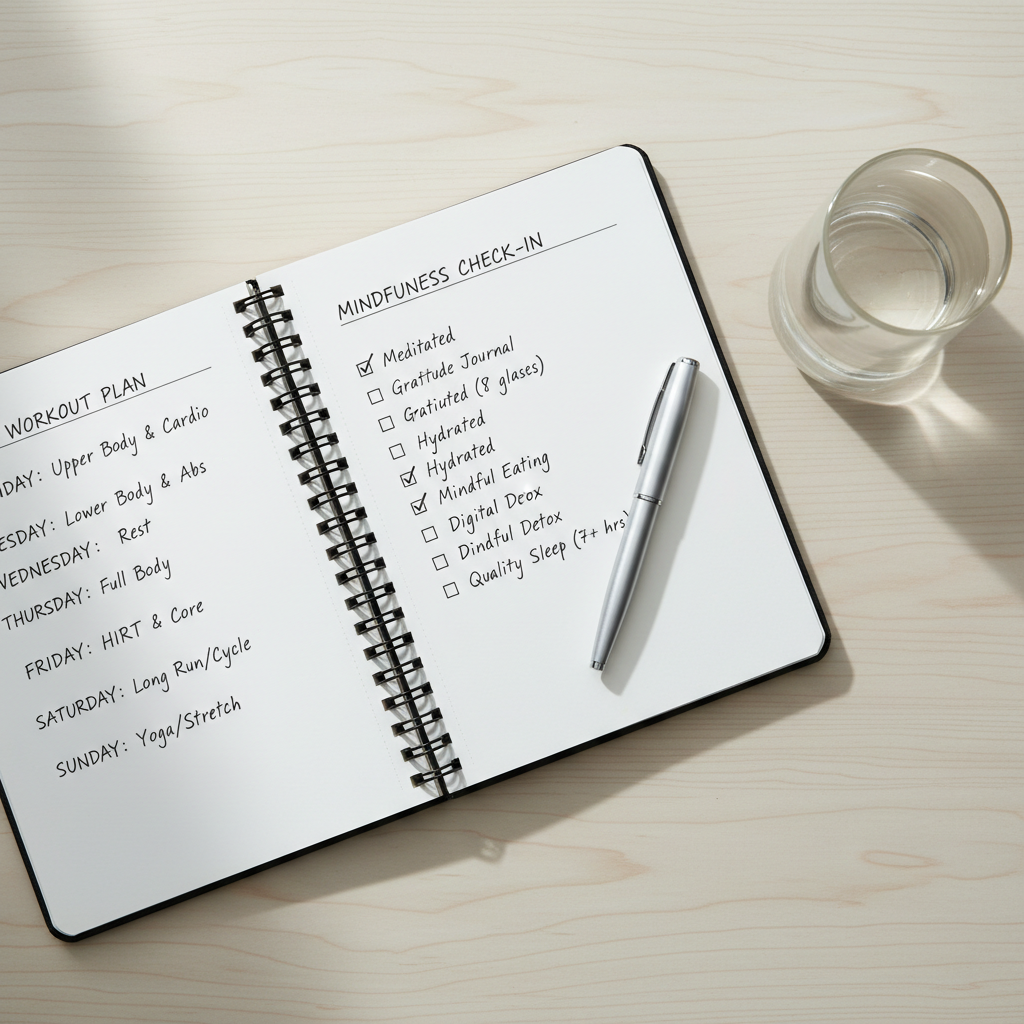
Practical tweaks by goal: strength, fat loss, endurance, and sport
Mindful Training looks slightly different depending on what you want, because the “right” cues differ.
Strength and muscle
- Use consistent setup rituals: stance, grip, brace, then lift.
- Track rep quality as a metric, not just weight.
- Stop sets when technique breaks past your agreed threshold, even if ego disagrees.
Fat loss and general fitness
- Use breath and talk-test checks to avoid accidental “all-out” days.
- Notice stress-eating triggers around workouts, not to judge yourself, just to plan better meals.
Endurance
- Scan for tension creep in shoulders and jaw, it wastes energy.
- Practice steady pacing with periodic form cues, especially when tired.
Sport performance
- Build a short reset routine between drills: exhale, relax the face, refocus on one objective.
- Use video review sparingly, then go back to one cue on the next rep.
Common mistakes that make mindfulness useless
Mindfulness sounds gentle, but people still manage to do it in a way that creates friction.
- Trying to be mindful for the entire workout: attention has limits, plan “focus moments.”
- Confusing mindfulness with low effort: you can be fully present and still train hard.
- Collecting cues like Pokémon: one or two cues beat seven cues every time.
- Ignoring pain signals: noticing discomfort is useful, pushing through sharp or escalating pain is risky.
According to the Centers for Disease Control and Prevention (CDC), gradual progression and paying attention to your body are important for safe physical activity. If something feels off in a way that keeps repeating, that matters.
When to get professional help (and what to ask for)
If you’re dealing with persistent pain, dizziness, numbness, or symptoms that worsen with training, it’s sensible to pause and consult a qualified healthcare professional. Online tips can’t evaluate your specific situation.
If the issue is more performance-based, a certified coach or physical therapist can help you connect mindful cues to mechanics and load selection. Useful questions to ask:
- “Which one cue will fix the biggest issue in my main lift?”
- “What load range lets me keep quality reps without guarding?”
- “How should I modify this movement for my current mobility?”
Key takeaways you can apply today
- Mindful Training is attention plus action: notice, adjust, repeat.
- One strong cue per lift beats a long checklist.
- Use a 10-second check-in and a quick post-set review to make progress visible.
- Hard training still belongs here, mindfulness just reduces wasted reps.
Conclusion: make your next workout “clean,” not complicated
If your training has felt inconsistent, try adding one mindful set per exercise for the next two weeks and keep a short note on what you noticed. That small structure tends to create momentum because you stop guessing.
If you want a simple starting point, choose one main lift this week, pick one cue, and treat every rep like it matters. Results usually follow the reps you actually pay attention to.
FAQ
How long does it take for Mindful Training to work?
Many people notice better consistency within a few sessions, especially with form and pacing. Bigger changes, like fewer flare-ups or steadier progress, often take a few weeks of the same simple process.
Is Mindful Training the same as meditation?
Not exactly. Meditation can support attention, but mindful lifting is more like “meditation with a task,” where the task is technique, effort, and decision-making under load.
Can mindful workouts still be intense?
Yes. In practice, awareness often makes intensity more productive because you push when it helps and back off when it turns into sloppy volume.
What if mindfulness makes me overthink my form?
That’s common. Limit yourself to one cue, and judge success by whether reps look and feel smoother, not whether everything feels perfect.
Do I need wearables to train mindfully?
No. Wearables can help with pacing, but perceived exertion, breathing checks, and a short training log usually cover the basics well.
Is Mindful Training safe for beginners?
Usually yes, because it encourages control and awareness. If you have medical concerns or prior injuries, it’s wise to consult a qualified professional for individualized guidance.
How do I combine mindful practice with progressive overload?
Keep the progression plan, but add a quality gate: increase load only when you can maintain the agreed technique standard and effort target across your working sets.
If you’re training consistently but results still feel random, a light Mindful Training layer can be the missing piece, not by adding more work, but by making your current work count. If you’d rather not troubleshoot alone, a coach can help you pick the right cues and build a plan that fits your schedule without turning every session into a mental project.